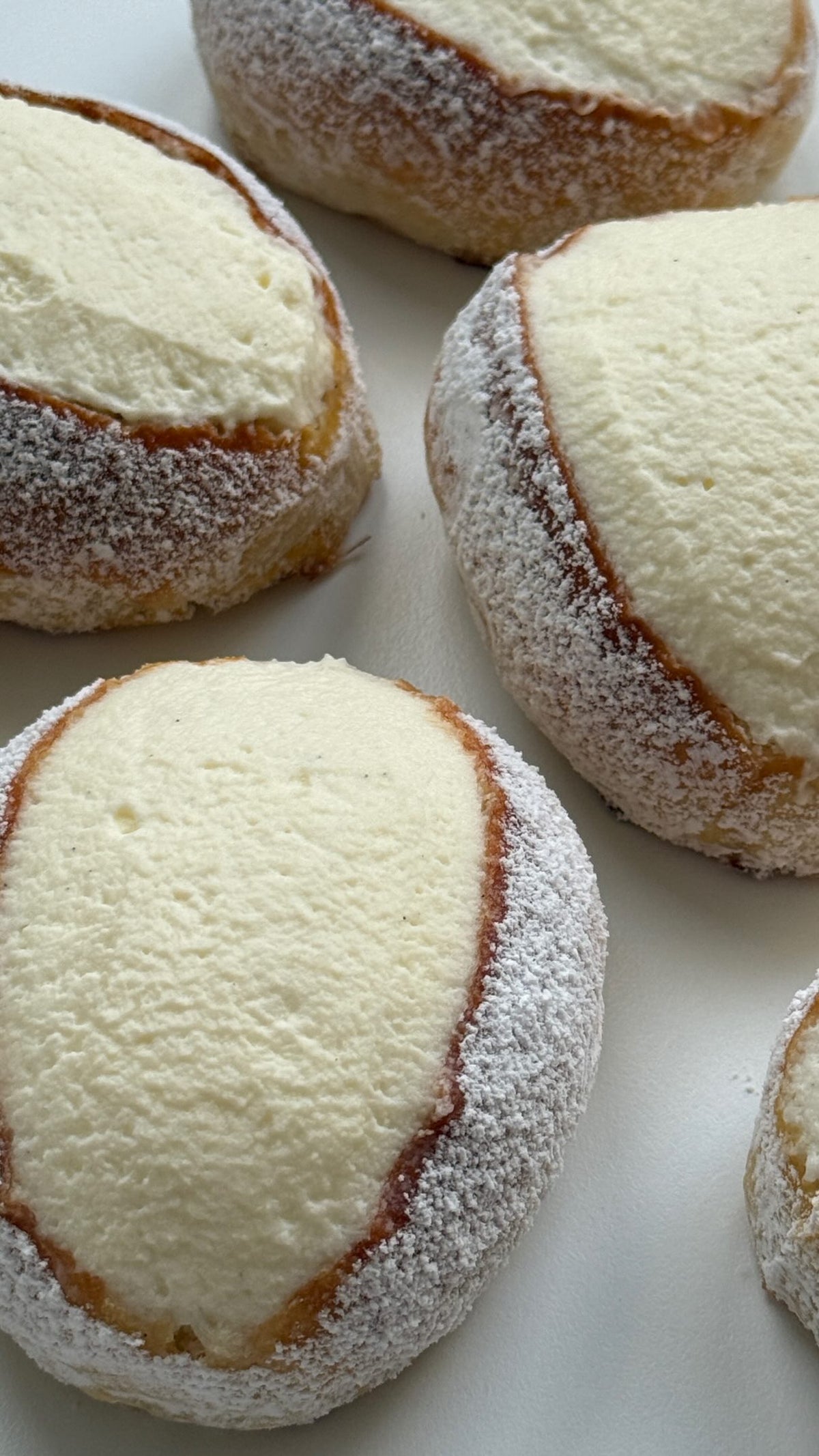
Vanilla Pastry von Food with Style, fertig angerichtet
Pastry

Vaniljbullar

Mjuka, saftiga jästbullar fyllda med en delikat vaniljkräm. Ett vackert bak som smakar alldeles himmelskt, både varma och kalla.

Dela
Portioner
10 stycken
Tillagning 18 minuter

Ingredienser

  • Till pensling & garnering

Gör så här

  1. 1
    Sikta mjölet i en bunke och gör en grop i mitten. Tillsätt jästen, 1 tsp socker och lite fingervarm mjölk. Låt stå 8-10 minuter tills det skummar.
  2. 2
    Tillsätt resten av sockret, ägget, mjölken, saltet och vaniljen. Arbeta ihop till en smidig deg, tillsätt sedan smöret och knåda 8-10 minuter tills degen är mjuk, elastisk och lätt blank.
  3. 3
    Täck över och låt jäsa 60-90 minuter, tills degen har dubblat sig.
  4. 4
    Värm mjölken med vaniljen (låt den inte koka). Vispa ihop äggulor, socker och majsstärkelse, vispa ner den heta mjölken och häll tillbaka allt i kastrullen.
  5. 5
    Låt koka under ständig omrörning tills krämen tjocknar och blir pudding-lik. Häll upp i en bunke, täck med plastfolie direkt mot ytan och låt kallna helt.
  6. 6
    Vispa den kalla krämen slät och lägg över den i en spritspåse med rund tyll.
  7. 7
    Dela degen i ca 10 bitar (50 g), rulla dem till bollar, kavla ut varje boll till en rund platta och markera mitten lätt med ett litet utstickare.
  8. 8
    Skär den yttre delen i tunna remsor och låt mitten vara hel.
  9. 9
    Spritsa en låg ring vaniljkräm i mitten och vik sedan remsorna försiktigt in mot mitten så att de överlappar något.
  10. 10
    Lägg ett blåbär i mitten, täck över och låt jäsa 20-30 minuter.
  11. 11
    Vispa ihop äggula och mjölk, pensla bullarna och grädda i 180 °C / 350 °F i 18-22 minuter tills de är gyllenbruna. Låt svalna en stund och pudra över florsocker. Mjuka, delikata jästbullar med en fin vaniljfyllning - luftiga, eleganta och helt enkelt oemotståndliga.

Video

Vanilla Pastry Questions

The vanilla cream is ideal for making ahead, since it has to cool completely anyway before it can be whisked smooth and piped. Cook it a day in advance, cover it directly on the surface so no skin forms, and chill it. The yeast dough is best shaped and baked the same day, but you can slow the 60-90 minute rise by letting it proof in the fridge and bringing it back to room temperature before dividing.

No, if nothing happens within the 8-10 minutes the yeast is either dead or the milk was too hot. The milk should be lukewarm, not hot, because heat above body temperature kills active dry yeast. Start that step again with fresh yeast and properly lukewarm milk, otherwise the dough will never double.

Yes, the 60 g soft butter can be swapped for a firm plant-based block butter, and both the 110 ml dough milk and the 250 ml milk for the cream can be replaced with a neutral, full-fat plant milk such as oat or soy. Keep the substitute butter genuinely soft, since it has to be kneaded into the already-smooth dough. The pastry cream still sets, because the thickening comes from the 25 g cornstarch and the 2 egg yolks, not the milk fat.

Lumps usually mean the hot milk went into the yolk mixture too fast, or the cream was not stirred constantly while cooking - pour the hot milk in gradually while whisking, and keep stirring the whole time in the saucepan. A runny cream means it did not cook long enough; the cornstarch needs to come up to a boil to thicken fully into a pudding-like consistency. If lumps appear anyway, pass the finished cream through a sieve before covering and cooling it.

Because they contain an egg-yolk-based cream, store them covered in the fridge rather than at room temperature. They taste best on the day they are baked, when the yeast dough is still soft. Let them sit out briefly before serving so the dough loses its chill, and dust with the powdered sugar only just before serving so it does not dissolve.

läckra, testade och redo att inspirera
Utforska 400+ Smakfulla Idéer